


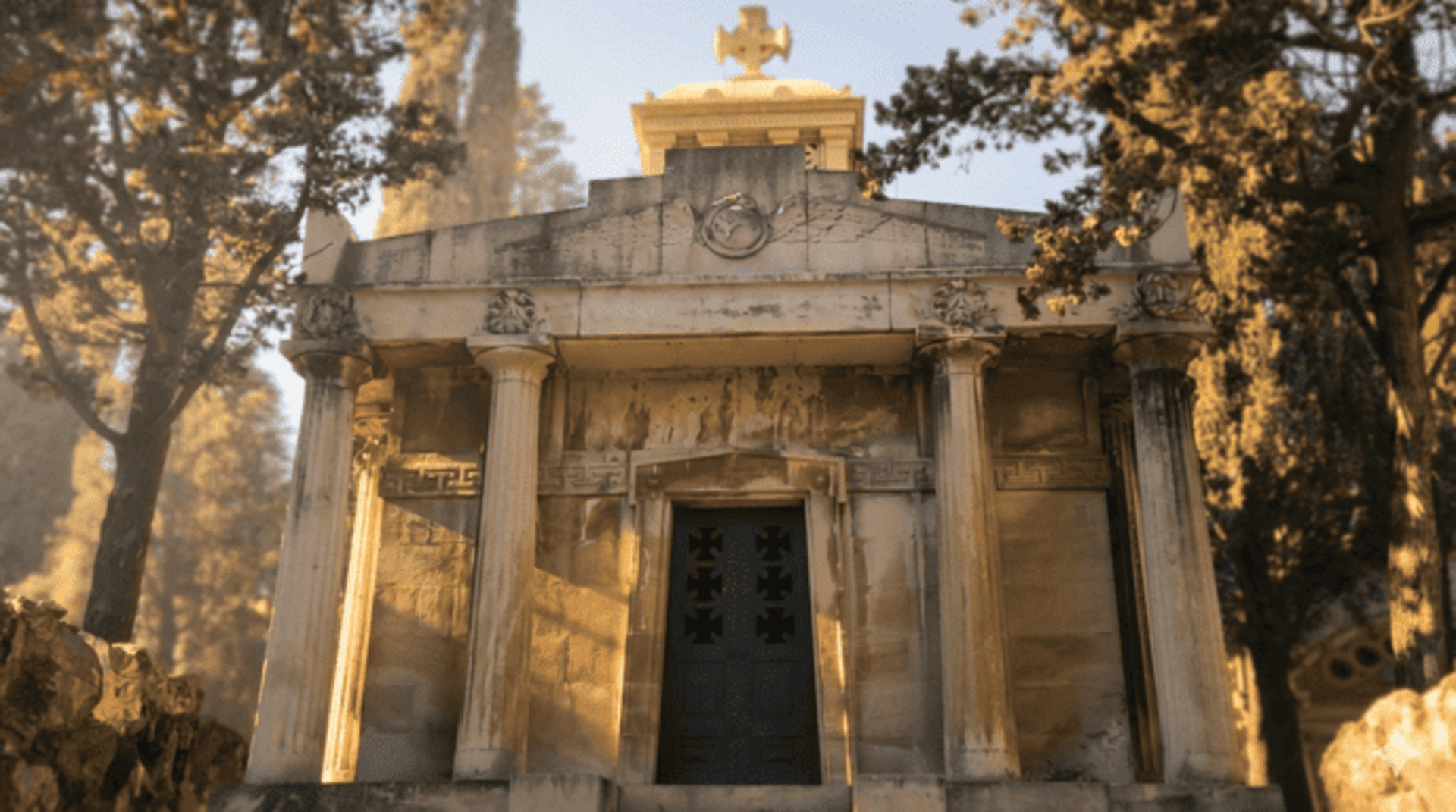
Portabella Family Mausoleum - Josep Portabella Cots
Roger Tarrats Balet
Portabella Family Mausoleum: The Eternal Neoclassicism of Domènec Balet (1892)
In the Montjuïc Cemetery (South-West), amid the solemnity of the grand bourgeois tombs, a piece of classic serenity stands out: the Portabella Family Mausoleum. Designed in 1892 by Master Builder Domènec Balet i Nadal, this funerary monument is a perfect example of neoclassical architecture applied to eternal rest.
Commissioned by the textile industrialist Josep Portabella Cots (the same man who commissioned him for his Neo-Gothic house on the Gran Via), this mausoleum reflects the status and sobriety of one of the most powerful families in industrial Barcelona.
Architecture: Symbolism and Classic Order
The mausoleum rises like a small Greek temple. Its facade is defined by Doric columns supporting a triangular pediment, providing a sense of balance and eternity.
Domènec Balet left nothing to chance in the symbolism:
The Ouroboros: At the top of the pediment, a relief of a winged serpent biting its own tail stands out. This ancient symbol represents the eternal cycle of life and death, the infinite rebirth.
The architect's signature: On the right side of the main staircase, Balet's signature can be found inscribed, claiming authorship of the work.
The design was so highly regarded at the time that it was presented at the Second Fine Arts Exhibition of Barcelona in 1894, demonstrating that funerary architecture was also considered major art.
The Patron: Josep Portabella Cots
Josep Portabella (1841-1921) was a giant of the textile industry. His company, "Manuel Portabella e Hijos," merged with Camil Fabra in 1884 to create the powerful corporation "Sucesora de Fabra y Portabella." They managed factories in Sant Andreu (the famous "Vapor del Fil"), La Sagrera, and Manresa, employing over 2,000 workers.
Interestingly, Portabella is also known today for his residence in Manresa, the modernist house "La Morera" (1905), which was recently acquired by the singer Rosalía.
Project Data Sheet
Project: Portabella Family Mausoleum.
Architect: Domènec Balet i Nadal.
Project Year: 1892.
Location: Montjuïc Cemetery (Agrupación 3ª, Vía de Santa Eulàlia, Plot No. 12).
Style: Neoclassicism.
Key Features: Doric columns, Ouroboros relief, Balet's signature.
Exhibitions: Presented at the 1894 Fine Arts Exhibition.
Frequently Asked Questions (FAQ)
Exactly where is the mausoleum located?
It is located in the South-West Cemetery (Montjuïc), specifically in Agrupación 3ª, Vía de Santa Eulàlia, number 12.
What does the serpent on the facade mean?
It is an ouroboros, a serpent or dragon biting its own tail to form a circle. It is a very common symbol in 19th-century funerary architecture representing eternity, the infinite cycle of life, and the cyclical nature of time.
Who is buried there?
Inside the mausoleum are the tombs of Josep Portabella Cots and his wife, Amalia Pavia. At the back, there is an entrance to the underground crypt where other family members rest.
Image Gallery: